Half-Life Engineering: How Incretin Drugs Went From Hours to Weeks
The sources give no half-life figure for retatrutide, but a weekly pen implies a molecule engineered to outlast the hormones it imitates.
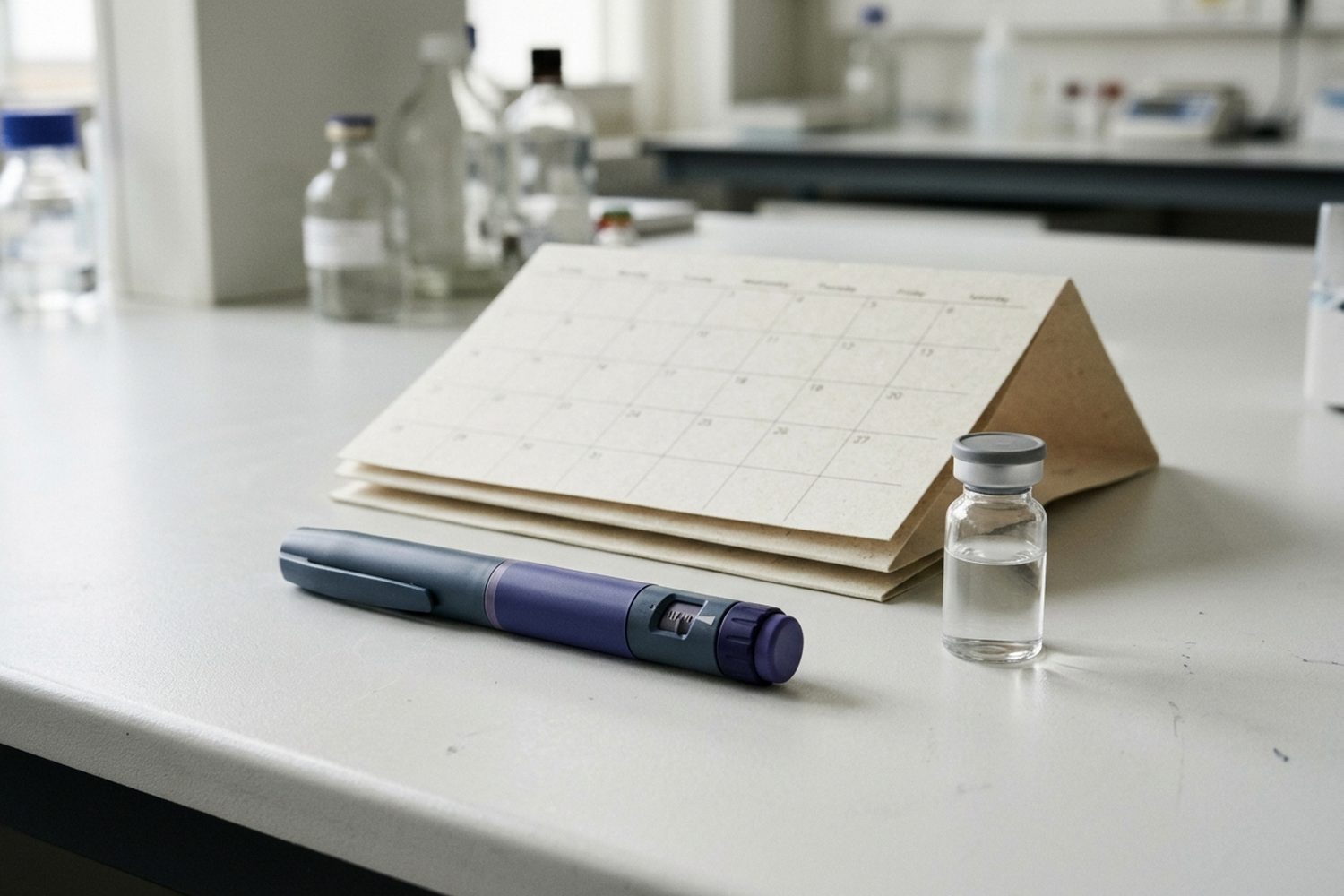
Retatrutide, Lilly’s experimental drug that hits three hormone receptors at once, is injected once a week. That’s the useful fact. The gut hormones it imitates do nothing of the sort, and the distance between what your intestines release after lunch and what goes into a weekly pen is most of what this article is about.
If you searched for the retatrutide half life hoping for a number of days, the sources this article relies on don’t give one. What they do settle is the schedule. In the phase 2 studies, doses ranged “from 0.5 mg to 12 mg weekly” in adults with type 2 diabetes and from 1 mg to 12 mg weekly in adults with obesity, and a systematic review of randomized trials describes the 12 mg dose as given once weekly. A drug injected weekly has to stay in the blood long enough to cover the week, so its half-life is long in the sense that matters. The exact figure isn’t settled here.
What the retatrutide half life tells you, and what it doesn’t
A half-life is the time it takes for half of a drug to leave the blood. It’s a dull number that ends up deciding almost everything else (which is true of most numbers worth knowing). It sets how often people inject, how steady the drug levels are between doses, and in practice whether the product is something people will keep using for 80 weeks.
And 80 weeks is the scale these trials run on now. TRIUMPH-1, the pivotal obesity trial, reported its topline on May 21, 2026, and AJMC wrote that retatrutide 12 mg “achieved a mean weight loss of 70.3 lb (28.3%) at 80 weeks.” (The results get their own careful article elsewhere on this site, so I’ll leave them there.) Results like that come from a molecule the body keeps around for days. Presumably nobody gets 28% off a drug that disappears before dinner.
Why not just inject the hormone the body already makes
Here is the sensible objection. The body already makes GLP-1, GIP and glucagon. They already bind the right receptors. So why not bottle the real thing and skip the chemistry?
It’s a fair question, because the natural hormones really are well designed for their receptors. A structural study of incretin receptors found that “ligands of incretin receptors adopt an α-helical conformation upon binding,” meaning the hormone coils into a spring shape and slots in. Evolution worked on that fit for a long time. It’s hard to improve.
The trouble is that the body also designed these hormones to vanish. A post-meal hormone is a text message, not a billboard: it says “food arrived,” gets read, and gets deleted. Enzymes cut it up and the kidneys filter out the pieces. That’s correct behavior for a signal. It’s terrible behavior for a product.
So the job is to make the hormone last longer. Actually, that’s not quite it, and the real version is stranger. The job is to build a molecule that still looks like the hormone to the one receptor that matters, and looks like nothing at all to every system the body uses to throw things away. The chemistry is less like making a sturdier hormone and more like teaching a hormone to sneak past security.
Hiding from the enzyme: DPP-4 resistance
The first guard is an enzyme called DPP-4 (its name is the least interesting thing it does), which clips the front end off incretin hormones and leaves them inactive. Getting past it means changing the peptide at the spot the enzyme recognizes, using a substitute the enzyme can’t cut but the receptor will still accept.
The constraint is tight. The structural study says the receptor’s outer domain “is important for ligand binding and ligand specificity,” while the part buried in the membrane handles activation. So every change risks breaking a handshake that took evolution a very long time to set up. You’re editing a key so one lock refuses it and a different lock still opens.
(I’ve spent more of my working life than I’d like to admit reading about enzymes that chop up peptides, and I’m not sure I’ve won a single argument with one.)
DPP-4 resistance alone doesn’t get you to a week, though. It gets you past the first guard. The kidneys are still there, filtering anything small, and a peptide is small.
Hitching a ride on albumin: acylation
The second trick is acylation: attaching a fatty acid chain to the peptide. The fatty tail makes the drug cling to albumin, a large and abundant protein in the blood. Albumin is too big for the kidneys to filter, so while the drug is attached it is, in effect, invisible to the exit.
You can picture the meeting where this started. “Hey, what if the drug just held onto something the kidney isn’t allowed to throw away?” (I made that up. I assume the real meeting had more slides.)
It works sort of like valet parking. Your car is safe in the garage, and nobody can tow it, but you also can’t drive it until someone brings it back. A drug bound to albumin isn’t hitting receptors. It comes off a bit at a time, does its work, and the rest waits. A long half-life is really a slow, steady release from a protein the body won’t discard. And there is a nice symmetry in that: the same study that described the helix found that “hydrophobic interactions are the main driving force” for hormones binding their receptors. Greasiness gets the drug held in the blood, and greasiness gets it gripped at the receptor.
The facts in front of me don’t say which of these tricks retatrutide itself uses, so I won’t guess.
Bolting on something huge: Fc fusions and antibody conjugates
If hitching a ride on a big protein works, the next idea is obvious. Become the big protein.
An Fc fusion attaches the active peptide to the Fc section of an antibody, the stem the body recognizes as one of its own durable proteins and recycles instead of destroying. An antibody conjugate goes further and links the peptide to an entire antibody. Either way the molecule is now huge, kidney filtration stops being a concern, and the body’s own antibody-recycling system keeps it in circulation. Amgen’s maridebart cafraglutide is the prominent antibody bet in this space, with its own article on this site, and it’s notable for blocking the GIP receptor rather than activating it, a paradox one review calls “a central unresolved scientific question in incretin pharmacology.”
The tradeoffs are real and mostly not settled by anything I have here. A bigger molecule is a different molecule. It may reach tissues differently and need different manufacturing. Whether it’s better or worse than a small acylated peptide is a design argument, not a known result.
Look, between us, the progression has a certain comedy to it. Step one, protect the hormone from an enzyme. Step two, attach a fat tail so it hides in a protein. Step three, staple it to an antibody, which is a little like protecting a letter from getting lost by mailing it inside a refrigerator.
Why weekly is the number everyone aims for
The engineering is in service of a schedule, and the schedule is weekly. It’s purely a coincidence, I’m sure, that “once weekly” also fits neatly across the front of a box.
It isn’t the only direction, mind you. A review of GLP-1 receptor biology lists the field’s three major axes as dual and triple agonists, “biased agonist design, and oral formulations.” The oral path abandons injected half-life engineering for small molecules like orforglipron, which produced weight loss of 11.2% at its 36 mg dose over 72 weeks in the ATTAIN-1 trial, and for peptides like amycretin, which a review reports at 13.1% loss over 12 weeks taken orally and 24.3% over 36 weeks injected. I don’t know which approach wins. Neither does anyone, which is what makes it a pipeline.
What a long half-life buys, in principle, is steady exposure, with no peaks and troughs. That’s a reasonable lens for one detail Lilly reported from TRANSCEND-T2D-1: “No weight loss plateau was observed with retatrutide,” with participants still losing weight at 40 weeks. That steady exposure explains it is my inference, not the trial’s finding. I mean, plenty of other things could explain it too.
(My job, for what it’s worth, is explaining to strangers why a peptide was given a fatty tail and an antibody chaperone. Nobody grows up planning on that.)
It’s fine that the half-life number isn’t in the sources. The schedule tells the story anyway. The gut sends a brief text after lunch and deletes it within the hour. Retatrutide sends one a week, and an entire field went to considerable trouble to make sure nothing in the body can delete it.
Sources
- GLP-1 receptor biology and the therapeutic role of incretin-based agonists in metabolic diseases
- Retatrutide Achieves Up to 30.3% Average Weight Loss in Phase 3 TRIUMPH-1 Trial | AJMC
- GLP-1 Obesity Drug Pipeline 2026: Trials & Dates by Quarter
- Lilly's triple agonist, retatrutide, demonstrated significant reductions in A1C and weight in first Phase 3 trial for treatment of type 2 diabetes
- Retatrutide-Associated Improvements in Cardiovascular Risk Biomarkers in Adults With Obesity With or Without Type 2 Diabetes
- Structural basis for ligand recognition of incretin receptors
- Orforglipron, an Oral Small-Molecule GLP-1 Receptor Agonist for Obesity Treatment.
- Orforglipron, an Oral Small-Molecule GLP-1 Receptor ...
- Amycretin in obesity: Mechanisms, clinical efficacy, and ...
- The Premise of the Paradox: Examining the Evidence That Motivated GIPR Agonist and Antagonist Drug Development Programs
Incretin Drug explains published research. It is not medical advice, and it never recommends a dose, a product or a seller. Talk to a clinician before you start, stop or change any medicine.