Survodutide: The GLP-1/Glucagon Dual Aimed at the Liver
A weight-loss drug that switches on the hormone that raises blood sugar, and leans on GLP-1 to tidy up afterward.
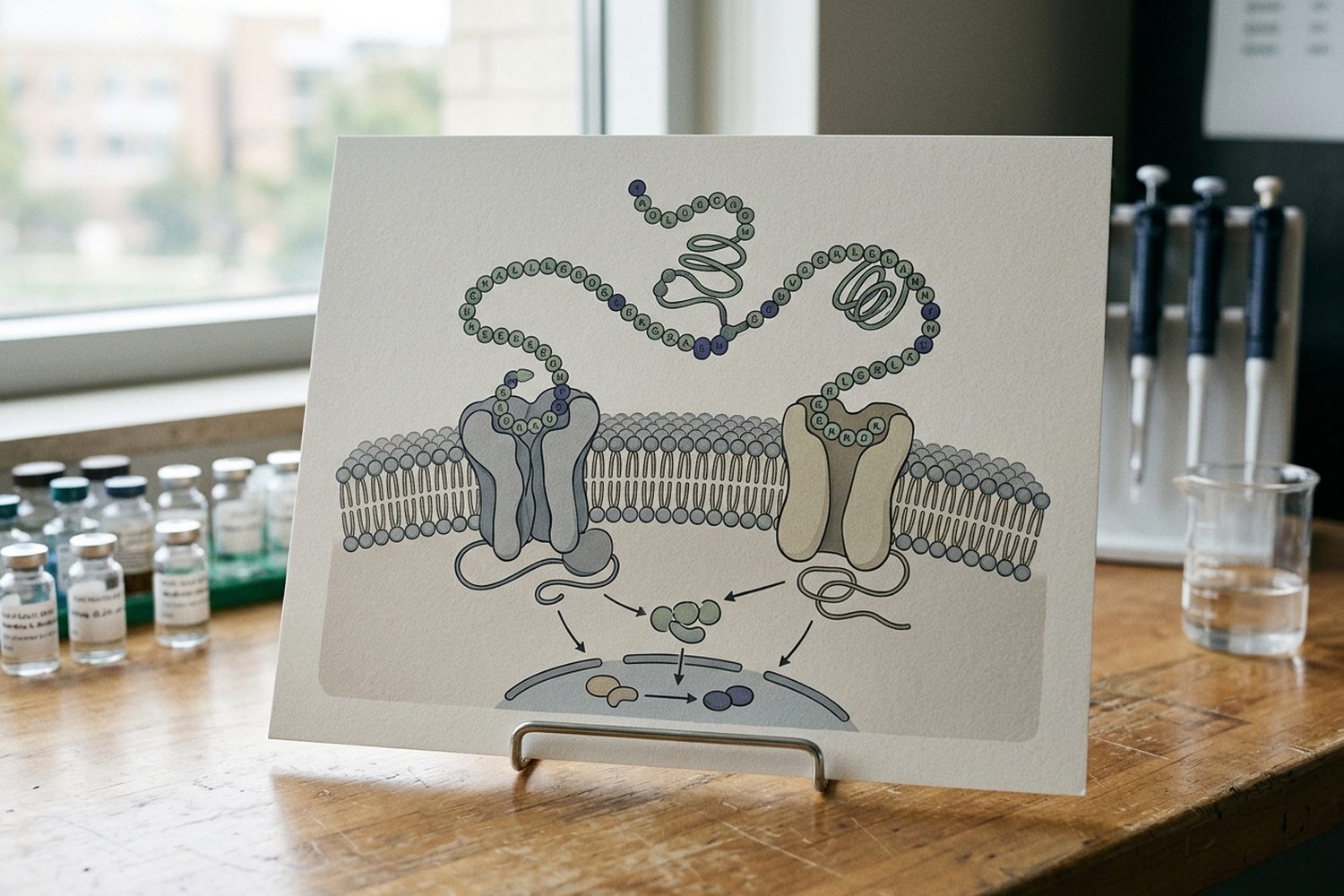
Here is a small fact about survodutide: it is a weight-loss drug that works partly by switching on the receptor for glucagon, a hormone whose normal job is to raise blood sugar. Survodutide is a single peptide that activates both the GLP-1 receptor and the glucagon receptor. Boehringer Ingelheim is developing it for obesity and for fatty liver disease, which is why it keeps getting described as the dual agonist aimed at the liver.
That is the plain answer, and the status is easy to state. A 2024 systematic review of obesity drugs counted 14 ongoing phase 3 trials and listed “mazdutide and survodutide (GLP-1/glucagon RAs)” among them. Survodutide’s first phase 3 topline results, from a trial called SYNCHRONIZE-1, were reported on April 28, 2026. The liver part rests on early trials in people with MASLD, the fatty-liver condition the program is built around, along with its more serious form, MASH. The rest of this post is about why anyone would design a drug this way. It is a strange design.
Start with a drug that does one thing
Begin with the reasonable version. A GLP-1 drug imitates a gut hormone that tells your brain you have eaten, so you eat less. That works. (The site has a whole article on what an incretin is, so I will skip the history.) Then someone added a second hormone, GIP, and got tirzepatide, which produced mean weight loss of 19.5% and 20.9% at its 10mg and 15mg doses in the SURMOUNT-1 phase 3 trial. Two hormones, both mostly about appetite and insulin. Still reasonable.
Now take the next step. Add glucagon.
Here is the mechanism in very plain words. You put a hormone that pushes blood sugar up into the same molecule as a hormone that pushes it down, and you hope the up and the down cancel while the other effects remain. The official name for this is dual GLP-1/glucagon receptor agonism. A 2025 review of glucagon signalling describes survodutide, mazdutide and retatrutide as “GCGR-based multi-agonists that also incorporate GLP-1 receptor-activating moieties to counteract glucagon’s hyperglycaemic effects.” Put differently, the GLP-1 half is partly there to clean up after the glucagon half.
The body does not normally run things this way. In the old rat-cell research, GLP-1 is proposed to suppress glucagon release through a middleman: it triggers somatostatin, which “in turn suppresses exocytosis in alpha-cells,” in that paper’s words. So nature uses GLP-1 to turn glucagon down, and survodutide asks both of them to work at full volume at the same time. I feel like this meeting went something like this (I invented it): “Hey guys, what if the molecule also did the thing the body uses GLP-1 to stop?” Then everyone looked at the liver data and decided it was not dumb.
Why glucagon is the hormone you send to the liver
It is hereby stipulated, for purposes of this discussion and without prejudice to any future article, that a hormone which raises blood sugar is an unusual ingredient for a family of drugs that is judged, in part, by how much it lowers HbA1c. The case for including it anyway rests on where glucagon works and what it does when it arrives.
On where: the glucagon review says the receptor “is expressed in the liver and kidney, and to a lesser extent in various other tissues,” which is how you would describe a receptor that has one serious relationship and keeps a few others discreet. The liver is the serious one. On what: glucagon promotes the breakdown of liver glycogen, and it “stimulates lipolysis and mitochondrial fat oxidation in the liver.” A fatty liver is a liver holding too much fat, and here is a hormone that tells the liver to burn its fat. The logic is not complicated. That’s fine.
There is also a whole-body version. A review of next-generation dual agonists says GLP-1/glucagon agonism “increases energy expenditure by stimulating fat oxidation and glucose production, distinguishing it from the appetite-focused GLP-1/GIP approach.” Tirzepatide gets you to eat less. A glucagon dual is meant to get you to eat less and also burn more. That is the pitch.
How far the escalation goes, and how far it has gone
Push the hypothetical one step further. If a drug can make the liver burn more fat, why not the rest of you? Then push it again: a drug that turns your body into a small furnace, so that weight loss arrives partly as heat. (This part is made up.) In the endpoint version, a patient on the drug heats their own apartment, the utility bill falls, and the trial’s key secondary endpoint is measured in BTUs. Somebody files a patent on the thermostat.
The real world is further along this road than you might expect. A recent paper on amino acids and thermogenesis reports that dual and triple GLP-1/GIP/glucagon agonists “promote thermogenic-like amino acid profiles in BAT with robust heat production,” where BAT is brown fat, the kind that burns energy to make heat. The same authors propose that these drugs trigger “sympathetic activation and adaptive thermogenesis” in brown and beige fat. Note “proposed.” That is a mechanism hypothesis about the class, mostly from lab work, not a measurement of survodutide in people. Nobody has shown the apartment-heating thing. Yet.
The chemistry of getting one peptide to fit two receptors is its own small spectacle. Cryo-EM studies of three other GLP-1/glucagon duals (cotadutide, SAR425899 and something just called peptide 15) found that receptor selectivity depends on how the first three amino acids sit in the deep binding pocket, and that interaction with a part of the receptor called extracellular loop 1 “plays an important role in executing dual agonism.” (I write about drug pipelines for a living, which mostly means reading the phrase “extracellular loop 1” and nodding in a way I hope looks informed.) Those structures are not survodutide’s. The principle carries over: you are tuning one key to turn two locks by different amounts, and the balance is the whole product.
What survodutide’s MASH and obesity data show so far
Now the numbers, and the gaps where the numbers should be. The glucagon review says that in early clinical trials, mazdutide, survodutide and retatrutide “each demonstrated substantial efficacy for weight loss in people with obesity while improving liver health in those with MASLD.” That is a summary, not a result table. The specific readouts from survodutide’s phase 2 MASH trial (how many patients saw their liver disease resolve, how much scarring improved, at which doses) are not in the sources I am working from, so I will not state them. That part is not settled here.
On weight, the cleanest figure comes from a network meta-analysis of glucagon receptor agonists, which put survodutide’s mean weight reduction at -10.74 kg versus placebo, with a 95% confidence interval of -15.68 to -5.80. That interval is wide. Network meta-analyses stitch different trials together, so treat the figure as an estimate rather than a head-to-head result. It is also in kilograms, while most headlines quote percentages, which makes lining it up against tirzepatide’s 20.9% a matter of guesswork. Is a glucagon dual better than a GIP dual? Those numbers do not let you say.
The phase 3 obesity program is the real test, and as of this writing the public record available to me holds only the date: SYNCHRONIZE-1 reported topline results on April 28, 2026. What those results said is not in my sources. Meanwhile the field has kept escalating. Retatrutide adds GIP on top of glucagon and GLP-1, and a newer triple, UBT251, posted -13.6% to -19.7% weight loss against -2.0% for placebo over 24 weeks in a phase 2 trial of 205 adults. Its makers say the GLP-1 and GIP activity offsets glucagon’s effect on blood sugar. Whether two balancing hormones beat one is the question the site’s triple-agonist pieces chase. Anyway.
One more detail, since it is printed right on the paper. The 2025 glucagon review quoted throughout this post was “funded by Boehringer Ingelheim Pharmaceuticals, Inc., which is developing survodutide.” Disclosed, routine, how a lot of this stuff gets written, lol. By its sponsor’s own paperwork, then, survodutide is not really a new GLP-1 drug. It is a glucagon drug, and the GLP-1 is the chaperone.
Sources
- Emerging pharmacotherapies for obesity: A systematic review
- Tirzepatide Once Weekly for the Treatment of Obesity
- Next generation dual GLP-1/GIP, GLP-1/glucagon, and ...
- Shared mechanistic pathways of glucagon signalling: Unlocking its potential for treating obesity, metabolic dysfunction-associated steatotic liver disease, and other cardio-kidney-metabolic conditions
- Amino acids contribute to adaptive thermogenesis. New insights into the mechanisms of action of recent drugs for metabolic disorders are emerging
- Glucagon-like peptide I and glucose-dependent insulinotropic polypeptide stimulate Ca2+-induced secretion in rat alpha-cells by a protein kinase A-mediated mechanism
- Structural analysis of the dual agonism at GLP-1R and GCGR
- GLP-1 Obesity Drug Pipeline 2026: Trials & Dates by Quarter
- Comparative Efficacy and Safety of Glucagon Receptor Agonists on Metabolic Outcomes: A Network Meta-Analysis of Randomised Controlled Trials
- Insights into the structure and activation mechanism of some class B1 GPCR family members
- UBT251, a novel triple GLP-1, GIP, and glucagon receptor agonist, in adults with overweight or obesity: A multicenter, randomized phase 2 trial.
- Novo Nordisk’s triple agonist delivers up to 19.7% weight loss
Incretin Drug explains published research. It is not medical advice, and it never recommends a dose, a product or a seller. Talk to a clinician before you start, stop or change any medicine.