When Will Retatrutide Be Available? The Regulatory Path
The strongest obesity drug trial result yet has no pharmacy, no label and a filing date, and the review clock has not started.
Today the most effective weight-loss drug anyone has tested in a big trial is not for sale anywhere, and its maker does not plan to ask the US government for permission to sell it until next year. The drug is retatrutide, from Eli Lilly. The Remy Research pipeline report describes its status about as plainly as a status can be described: it “is not approved in any country.”
So, when will retatrutide be available? Not before 2027, and probably not until well after the start of it. Lilly plans to submit retatrutide for US regulatory approval in Q1 2027. A normal FDA review runs 10 to 12 months. Add those together and you get a plausible approval around early 2028, assuming the review goes smoothly and nothing speeds it up or slows it down. The available facts settle neither of those things.
Why the answer to when retatrutide will be available is a filing date
The way to think about this is to follow who gets paid for what. Lilly gets paid when it sells a drug. It can sell a drug in the US only after the FDA approves it. The FDA approves a drug when it receives a filing showing the drug works and is safe enough. The filing is built out of Phase 3 trials. Phase 3 trials take years.
Every link in that chain is reasonable. Each one exists because, at some point, someone sold something that did not work, or worked and also did something else. The chain is slow on purpose. Slowness is the product.
The chain also ends somewhere nobody designed. We’ll get there. It involves vials.
What the Phase 3 readouts actually showed
The first Phase 3 result was TRANSCEND-T2D-1, a trial in adults with type 2 diabetes whose blood sugar was not controlled by diet and exercise alone. It ran 40 weeks with 537 participants. HbA1c (a measure of average blood sugar) fell by 1.69, 1.86 and 1.94 percentage points at the 4 mg, 9 mg and 12 mg doses, against 0.81 for placebo. Weight fell 11.5%, 13.9% and 15.3%, against 2.6% for placebo.
The big one was TRIUMPH-1, an 80-week obesity trial that reported its topline on May 21, 2026. On the 12 mg dose, people lost 28.3% of their body weight. Well, more precisely: they lost 28.3% by the “efficacy estimand” (n=2,339), and “up to 25%” by the “treatment-regimen estimand,” which are two different statistical answers to the question of what happened in the same trial. Roughly, one asks what the drug does when people stay on it as planned, and the other counts everyone who was assigned to it. Drug companies report both (it would be rude to waste a perfectly good estimand). The bigger number gets the headline.
Either way it is a lot. The 12 mg group started at an average body weight of 248.5 lb and lost an average of 70.3 lb. Of those participants, 45.3% lost 30% or more of their body weight, and 65.3% got their BMI below 30. In a blinded extension for people who started with a BMI of 35 or higher, the 12 mg group reached 30.3% weight loss by week 104. AJMC summarized it this way: “All three doses of retatrutide (4 mg, 9 mg, 12 mg) met the primary and key secondary endpoints in TRIUMPH-1.”
There is also TRIUMPH-2, a Phase 3 trial in adults with both obesity and type 2 diabetes. Its results are not in the material I’m working from, so I won’t pretend to know them. They will presumably show up in the filing. (The site’s other retatrutide articles go through the numbers more carefully than this one has room to.)
Why Lilly files in 2027 instead of now
Here is the puzzle. The headline obesity data came out in May 2026. The filing is planned for Q1 2027. Why the gap?
The facts do not say. Presumably the answer is boring. A topline is a press release (a genre whose main virtue is fitting on one screen). A filing is a regulatory dossier that has to contain everything, from full datasets for every trial to safety tables and manufacturing details. I assume Lilly also wants more of its Phase 3 program finished, so the label covers more uses. (I write about drug trials for a living, which mostly means reading the word “estimand” more times per week than any normal person reads it in a lifetime, and even I would not want to assemble one of these.)
It’s fine. The incentive actually points the same way as the patience. A drug that gets approved for a narrow use and then has to come back for a broader one has spent years selling less than it could have. A drug that files once, with everything, launches big. I’d rather not think too hard about what Lilly’s launch planners have penciled in for its competitors.
You can picture the conversation at the agency, which I am inventing: “Hey, thanks for the 80-week topline, love the chart, can we see the actual data now?”
How long the FDA takes once it has the file
The normal FDA review takes 10 to 12 months. There is a newer program, the Commissioner’s National Priority Voucher, which according to BioSpace “sought to shorten FDA regulatory review timelines” to 1 to 2 months. That would turn a year into a few weeks, which is sort of the regulatory equivalent of an airport fast lane that skips security, check-in and also most of the airport.
But look, the same BioSpace report was about the FDA delaying decisions for Lilly’s obesity pill orforglipron and other voucher holders. So the fast lane has, at least once, been slower than the sign promised. Whether retatrutide gets a voucher at all is not in the facts. I don’t know, and none of the reports I’m working from say.
So here is the arithmetic, between us. Filing in Q1 2027. Add a normal review. Approval, if it comes, lands somewhere around early 2028. Add a voucher that works as advertised and it could be spring 2027. Add a voucher that works the way the orforglipron one did and nobody can tell you. That is a range, not a date, and it is the honest one. Then there is the time to manufacture, ship and get the drug covered, which is its own chain I won’t follow here.
Why research peptide sellers are not the answer
Now the end of the chain. Lilly makes money only after approval. The FDA approves only after the trials and the review. So for several years there is a drug with a 28.3% headline and no legal way to get it outside a trial. Demand does not wait for the review clock.
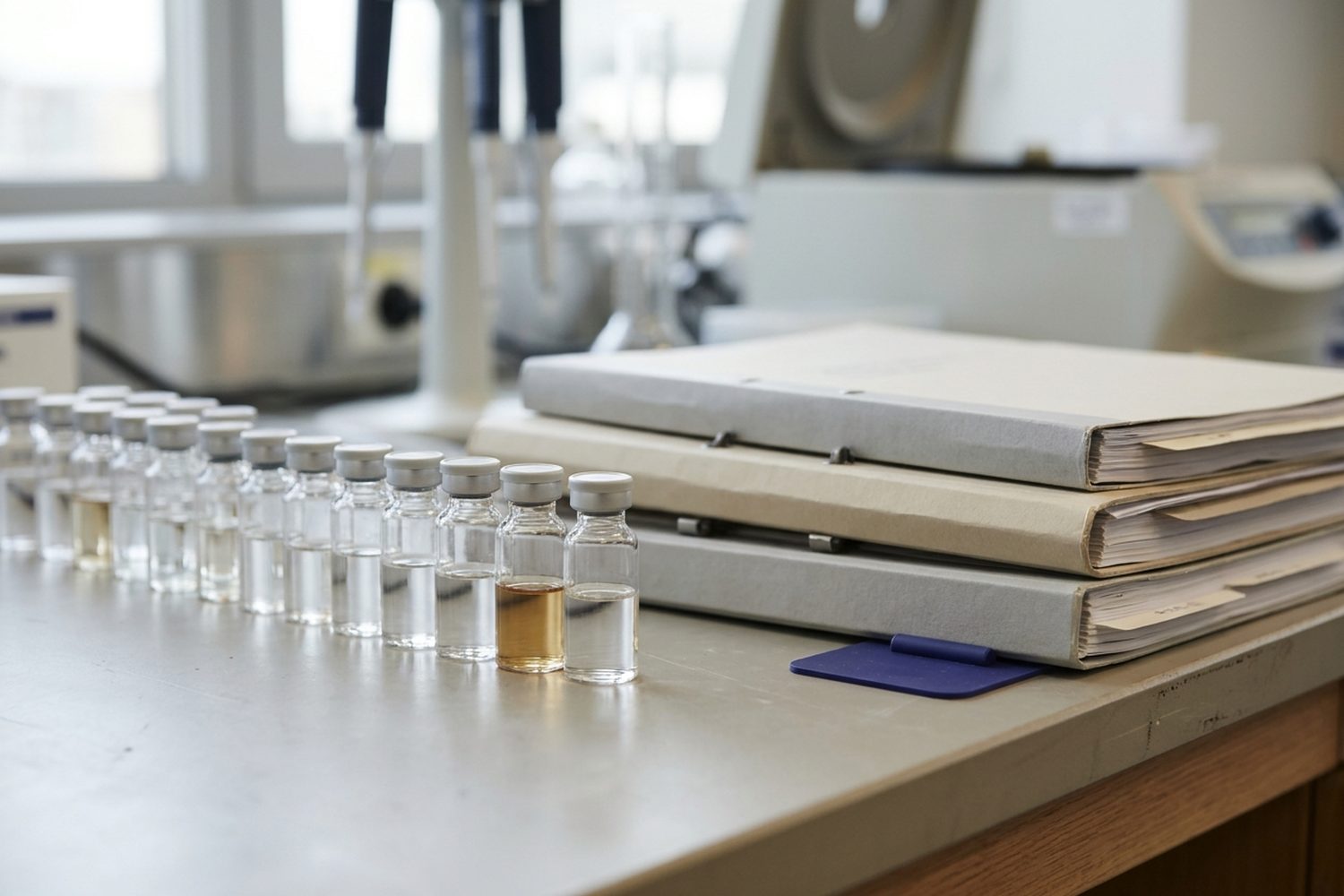
So websites sell vials labeled “retatrutide,” marked for research use. I mean, consider what that label is actually doing. The thing the trials tested is a specific molecule, made a specific way. An explainer titled What Is Retatrutide? calls it “an engineered amino-acid sequence rather than a naturally occurring human peptide,” and notes it had to stay active at three different receptors while keeping its stability, receptor affinity and pharmacokinetics all at once. That is hard chemistry. Whether a given vial contains that molecule, at that purity, in that amount, is exactly what the regulatory path exists to check. For these vials, nobody has checked.
Here is a made-up scenario, to be clear invented. A seller lists “retatrutide, for research only.” Customers ask for dosing guidance. The seller cannot give it without admitting the research is happening in people, so the listing adds “not for human use.” Sales rise. The seller adds a lab coat to the product photo. Sales rise again. Eventually the vial has more disclaimers than peptide, and the most carefully tested thing in the box is the font.
None of this makes the drug available. Availability, in the sense the search phrase means, is an approval and a pharmacy and a label. Everything before that is just the chain running. In the beginning, before anyone outside a lab had heard of it, retatrutide was known only by its research identifier, LY3437943.
Sources
- GLP-1 Obesity Drug Pipeline 2026: Trials & Dates by Quarter
- Efficacy and safety of retatrutide, a GIP, GLP-1, and glucagon receptor agonist, in people with type 2 diabetes and inadequate glycaemic control with diet and exercise (TRANSCEND-T2D-1): a double-blind, randomised, phase 3 trial.
- What Is Retatrutide? Synthetic Peptide Structure & Research
- FDA Delays Decision for Lilly’s Obesity Pill Orforglipron, Other Priority Voucher Awardees: Report - BioSpace
- Retatrutide Achieves Up to 30.3% Average Weight Loss in Phase 3 TRIUMPH-1 Trial | AJMC
Incretin Drug explains published research. It is not medical advice, and it never recommends a dose, a product or a seller. Talk to a clinician before you start, stop or change any medicine.