Amylin: The Other Satiety Hormone
Drugmakers have found a second satiety hormone to stack on GLP-1, and the open question is whether it fixes anything or only overrides.
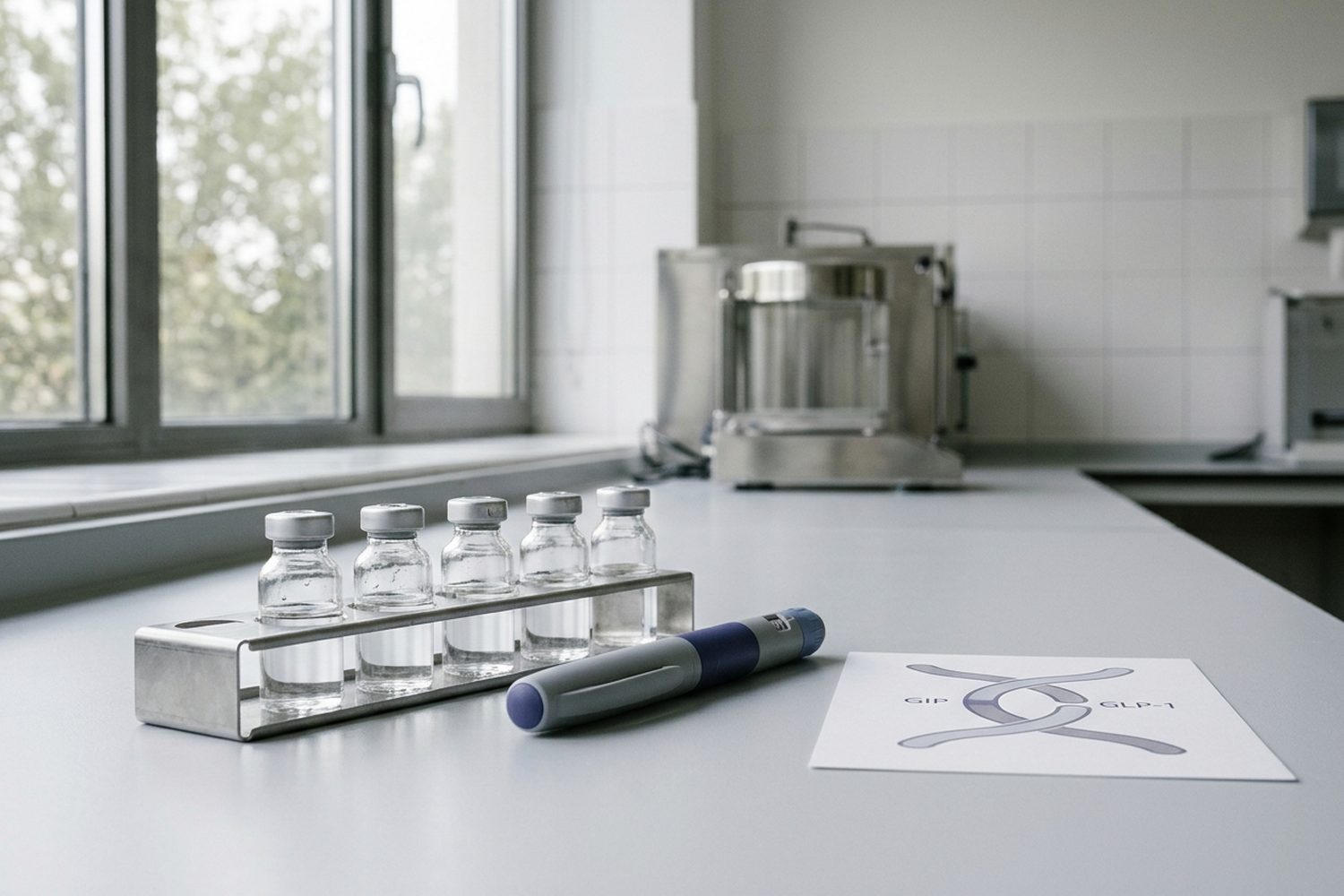
The most-watched obesity drug combinations right now take a GLP-1 drug, which already works quite well, and bolt on a second hormone that most people outside endocrinology have never heard of. That hormone is amylin. It is having a moment.
Plainly: amylin is a satiety hormone, and drugs that act on amylin receptors are being paired with GLP-1 drugs or built into the same molecule as them. The leading examples are CagriSema, a combination product that produced 22.7% mean weight reduction in its REDEFINE 1 trial, published in NEJM, and amycretin, a single molecule that hit 24.3% weight loss over 36 weeks as an injection. A 2026 review describes amycretin’s mechanism as “synergistically engaging hindbrain-mediated satiety pathways and delaying gastric emptying to overcome metabolic plateaus.” That sentence is most of what the drug industry wants from amylin. The rest of this piece is about why.
What amylin does, as far as drug developers care
There are two parts to that review’s description. The first is the hindbrain, the old back part of the brain that handles a lot of unglamorous bodily bookkeeping, including the feeling of having eaten enough. The second is gastric emptying, which is how fast your stomach passes food along.
The gastric part works a bit like a restaurant kitchen that slows the pace of courses. If the main arrives forty minutes after the appetizer, a lot of people skip dessert, not out of virtue but because the appetizer has had time to register. Same food, different timing, less eating. (The kitchen is not trying to help you. It is just slow.)
Amylin is not the only hormone in this business. GLP-1, according to structural work on its receptor, has “essential roles in regulating insulin secretion, carbohydrate metabolism, and appetite,” which is the line from the Cryo-EM paper that described the activated GLP-1 receptor. The point is that GLP-1 and amylin both touch appetite, but through receptors that are not the same receptor. That is what makes pairing them interesting rather than redundant.
There is also a third receptor in the story. Metabolic Care Today describes amycretin as “a unimolecular peptide agonist of GLP-1, amylin, AND calcitonin receptors (three receptor targets).” The capital AND is theirs. Calcitonin receptors keep showing up next to amylin receptors in these programs, and the drugs are designed to hit both.
The first amylin drug, and what these sources do not say
This is where I would normally tell you the founding story: who made the first amylin analog, when it was approved, how it sold, why it faded. I write about drug pipelines for a living, which mostly means reading the same three percentages in forty different press releases, and I would love to do the history part. But the source material behind this article does not document that history. So the dates, the sales, and the reasons it did not become a blockbuster are not settled here, and I am not going to make them up.
What the sources do settle is that amylin analogs are back, in a pipeline that is very crowded. A 2024 systematic review found 14 ongoing phase 3 trials for obesity drugs, and CagriSema, listed as a “GLP-1 RA/amylin agonist,” was one of them. The same review found that almost half of the antiobesity drugs in phase 2 were incretin analogs. Weird thing to say about any market. Half the queue is the same idea.
There are, roughly, three ways to read the amylin comeback
The first reading is the biology one. GLP-1 drugs reduce appetite, amylin drugs reduce appetite through a different route, and two routes beat one. CagriSema is described by the American Diabetes Association as “a fixed-dose combination of semaglutide (a GLP-1 receptor agonist) and cagrilintide (an amylin analogue).” That is about as simple as drug design gets: take a good drug, add a second good drug, sell them together. Amylin turns out to be a very sexy partner here. It hooks up with semaglutide in one product, and both sides seem to get more out of the arrangement than either did alone. That’s fine. Plenty of good medicine is just two things in one box.
For scale, tirzepatide, a dual GIP/GLP-1 agonist, produced 19.5% and 20.9% mean weight reduction at its 10mg and 15mg doses in the SURMOUNT-1 trial. CagriSema’s 22.7% is a bigger number. But those were different trials with different people, and comparing headline numbers across trials is a thing everyone does and everyone is told not to do. One reading is that amylin adds real weight loss on top of GLP-1. Another is that the gap between two separate trials is small enough that it mostly tells you both approaches are very good, and not much about how much the amylin half is pulling. The sources here do not pick between those.
The second reading is the business one. If half of phase 2 is incretin analogs, then having a GLP-1 drug is not a differentiator. It is table stakes (the phrase every strategy deck reaches for, and now this article too). It is like a basketball league where every team signed the same point guard, and now the whole game is who has the best forward. Somewhere in a pharma strategy meeting, someone said, “Okay, everyone has a GLP-1. What’s our GLP-1-plus?” and someone else said, “There’s this satiety hormone nobody is using.” I feel like this reading is true and also not a criticism. Companies need a reason for their drug to exist, and a second mechanism is a pretty good reason.
The third reading is the least comfortable. Maybe adding amylin is not just about going higher but about the fact that one hormone runs out of road. The amycretin review’s phrase is “overcome metabolic plateaus,” which assumes plateaus are a problem worth engineering around. And a separate review, titled Restoring Satiety After GLP-1/GIP Pharmacotherapy, notes that weight regain after stopping GLP-1/GIP therapy “is associated with alterations in the hunger-satiety axis, including increased ghrelin and reduced leptin signalling.” The same review says plainly: “It remains unclear whether pharmacological suppression of appetite by GLP-1/GIP agents results in sustained normalisation of endogenous satiety regulation after treatment cessation.” Translated: nobody knows yet whether these drugs fix the body’s own fullness system or just override it while you take them. If it is override, then stacking amylin on top is not a cure for the plateau. It is a second override. Which might be fine, or might mean the long-run business is selling more switches forever.
How you put amylin and GLP-1 in one molecule
The combination approach is two drugs. The more ambitious approach is one molecule that does both jobs, which is what amycretin is.
How does one peptide talk to several receptors? Structural work on incretin receptors describes a two-step binding model for the receptor family called class B1, which are “polypeptide hormone receptors characterized by having a large N-terminal extracellular domain.” Residues near the tail end of the hormone (the C-terminus) grab onto that big outer domain. Residues near the front end (the N-terminus) reach into the part of the receptor that crosses the cell membrane and actually transmit the signal. So a peptide is sort of a key with a handle and a blade, and designers can tinker with each end. Whether that exact model transfers neatly to amylin and calcitonin receptors is not something these sources settle, so take it as the general shape of the problem, not a blueprint.
Amycretin’s results so far come in two forms. As an oral drug, it showed 13.1% weight loss at 12 weeks. As an injection, 24.3% over 36 weeks. Those are different durations and different routes, so the two numbers are not a contest. They are a sign that the same molecule is being pushed down both paths at once.
What the next amylin drugs look like
The next step is the one GLP-1 already took: get rid of the peptide entirely and make a pill out of a small molecule. Lilly’s orforglipron did this for GLP-1 (its FDA decision date moved from March 28 to April 10, 2026, which is the most pipeline-ish sentence I will write today). Structure Therapeutics is trying the same thing for amylin with ACCG-2671, described as “a novel oral small-molecule DACRA with high binding affinity at human calcitonin receptor (CTR) and amylin receptor (AMY3R).” DACRA means dual amylin and calcitonin receptor agonist. In obese rats it showed dose-dependent weight loss, “with additive effects in combination with semaglutide.”
Between us, “additive effects in rats” is a sentence that has preceded a lot of drugs and a lot of non-drugs, and rats are not people. Anyway, it is early. But the shape of the bet is clear: an amylin pill to sit next to a GLP-1 pill, or whatever combination survives the trials.
None of this is settled. CagriSema and amycretin have strong numbers, the small-molecule amylin work is preclinical, and the basic question of whether appetite drugs reset anything is open. It is a little dumb that the second-most-important satiety hormone in this pipeline spent years as a footnote, lol, but drug development runs on what is fundable, and for a while one hormone was enough.
Hunger, it turns out, has more than one switch, and the plan is to press them all.
Sources
- Amycretin in obesity: Mechanisms, clinical efficacy, and ...
- CagriSema 2.4 mg / 2.4 mg demonstrated 22.7% mean weight reduction in adults with overweight or obesity in REDEFINE 1, published in NEJM
- CagriSema Demonstrates Significant Weight Loss in Adults with Obesity | American Diabetes Association
- Coadministered Cagrilintide and Semaglutide in Adults with Overweight or Obesity
- Amycretin Trial Shows Promising Weight Loss Results | Metabolic Care Today
- 2184-LB: Novel Oral Small Molecule ACCG-2671—A Dual Amylin and Calcitonin Receptor Agonist Development Candidate for Obesity Therapy
- Emerging pharmacotherapies for obesity: A systematic review
- Cryo-EM structure of the activated GLP-1 receptor in complex with a G protein
- Insights into the structure and activation mechanism of some class B1 GPCR family members
- Structural basis for ligand recognition of incretin receptors
- Restoring Satiety After GLP-1/GIP Pharmacotherapy: Metabolic Stability, Diet Quality, and the Gut Microbiota
- Amycretin in obesity: Mechanisms, clinical efficacy, and future perspectives
- FDA Delays Decision for Lilly’s Obesity Pill Orforglipron, Other Priority Voucher Awardees: Report - BioSpace
- Tirzepatide Once Weekly for the Treatment of Obesity
Incretin Drug explains published research. It is not medical advice, and it never recommends a dose, a product or a seller. Talk to a clinician before you start, stop or change any medicine.