CagriSema: Pairing Semaglutide With Amylin
Novo Nordisk proved its new drug beat its old drug, then discovered the market was grading against someone else's.
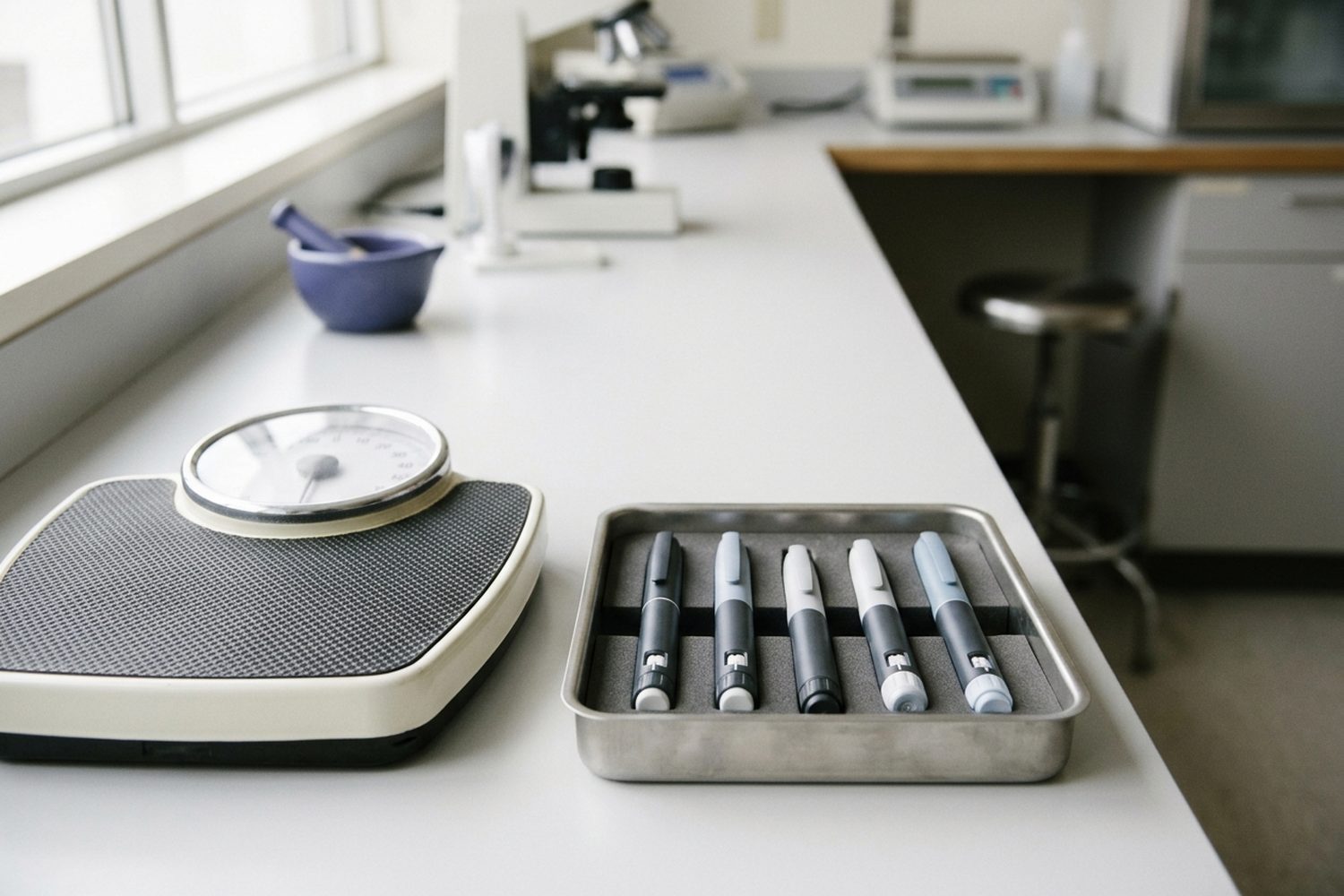
Novo Nordisk ran a trial in which 2,108 people got its new drug and 302 people got its old drug. The new drug was the old drug plus another drug. (This is a perfectly normal thing to do in drug development, and also a slightly funny thing to do, and we will get to both.)
CagriSema is Novo Nordisk’s combination of semaglutide, the molecule it already sells as Ozempic for type 2 diabetes and Wegovy for weight loss, with cagrilintide, an amylin analogue. In REDEFINE 1, its main obesity trial, people on the combination lost an average of 22.7% of their body weight at 68 weeks under one way of counting and 20.4% under another, against 2.3% to 3.0% on placebo. Semaglutide alone got 14.9%. By any ordinary standard that is a very large result. The market’s reaction was more muted than that, and the reason has less to do with the drug than with the yardstick.
Why you would bolt a second drug onto your best seller
Start with who gets paid for what. Novo gets paid for semaglutide. Semaglutide has also piled up evidence beyond weight. The SOUL trial showed fewer major cardiovascular events with the oral version. The FLOW trial supports kidney and heart protection in people with type 2 diabetes and kidney disease. It also improves symptoms in obesity-related heart failure with preserved ejection fraction. That is a lot of work already done on one molecule.
Then a different molecule, tirzepatide, which Novo does not sell, showed up. SURMOUNT-5 was a head-to-head trial of tirzepatide against semaglutide for obesity, and in the Japanese obesity-disease subgroup at week 72, tirzepatide beat semaglutide by 7.2 percentage points of body weight. (The site’s tirzepatide article covers how it manages that.) So Novo needs a next product.
Here is the appeal of a combination. You keep the molecule you know how to make, the one with outcomes data, and you add a second one that works through a different hormone system. The NEJM paper describes it plainly: “CagriSema is a fixed-dose combination of semaglutide (a GLP-1 receptor agonist) and cagrilintide (an amylin analogue).” Presumably the hope is that the two add up. (The amylin article on this site explains why anyone thinks they would.)
How REDEFINE 1 was built, and who got what
If you sell a combination, you have to show that each half earns its place, which means a trial with arms for the combination, each piece alone, and placebo. REDEFINE 1 randomized 3,417 people in a 21:3:3:7 ratio: 2,108 to CagriSema, 302 to semaglutide, 302 to cagrilintide and 705 to placebo.
The lopsided ratio makes sense. You want lots of safety data on the thing you plan to sell. You need only enough people in the single-drug arms to show the combination beats them. I suppose the semaglutide arm is a little strange from Novo’s side, since the comparator is its own blockbuster, and the goal is to make it look worse.
It did. A post hoc analysis looked at how many people got both their BMI under 27 and their waist-to-height ratio under 0.53 by week 68: 30.3% on CagriSema, 19.1% on semaglutide, 9.0% on cagrilintide, 3.3% on placebo. Each piece helps. Together they help more.
Which number is the number
Trials like this report results under different estimands, which are ways of handling people who stop taking the drug. The treatment-policy estimand counts everyone as randomized, quitters included, and gave CagriSema 20.4% against 3.0% for placebo. The adherence estimand asks what happens to people who actually stay on it, and gave 22.7% against 2.3%.
Both are legitimate. They answer different questions. The press-release headline used 22.7%. I’m sure that choice was made after long and genuine reflection on which question the public most wanted answered.
The second obesity trial, REDEFINE 2, in people with type 2 diabetes, came in lower: 13.7% against 3.4% placebo on treatment policy, 15.7% against 3.1% on adherence. People with diabetes tend to lose less on these drugs, so this is not a scandal. It is just a smaller number.
Why the CagriSema market reaction was what it was
The sources here do not record the share price move, or what number investors had penciled in beforehand, so I won’t state either. What is settled is how the comparison works, and the comparison is not against placebo. It is against tirzepatide.
Here is the call you can picture, invented but not hard to invent. “Congratulations on the result,” an analyst says. “Can you walk us through the gap to tirzepatide?” Nobody on that call is asking about placebo.
A 2026 network meta-analysis, which stitches separate trials together against a common placebo, put tirzepatide 15 mg at 17.97% weight reduction versus placebo and CagriSema at 17.84%. The difference is 0.13 percentage points. Thirteen hundredths. For a 200-lb person, that is about four ounces of body weight, roughly a sandwich, across more than a year of treatment. It is well inside the noise of comparing trials that were never run against each other. It is also, for marketing purposes, second place.
And second place with two molecules instead of one. Making two peptides costs more than making one, presumably. A 2026 meta-analysis found injection-site reactions about three times as frequent as with semaglutide alone (RR 3.14), though gastrointestinal side effects were not significantly increased. So the pitch becomes: as good as the rival, more complicated to make. It’s fine. It is just not the pitch anyone wanted.
It is like running a marathon in a personal best and learning that the guy who started next to you finished at the same moment, carrying less.
What REIMAGINE 2 and the meta-analyses added
REIMAGINE 2 tested CagriSema in type 2 diabetes against semaglutide at two doses each, plus cagrilintide and placebo. At the top doses, weight loss at 68 weeks was 14.2% versus 10.2% (efficacy estimand) or 12.9% versus 9.2% (treatment regimen). HbA1c fell 1.91 points versus 1.76 from a baseline of 8.2%. Novo Nordisk’s announcement said CagriSema showed “superiority over semaglutide on both weight loss and HbA1c across all tested doses.” Novo said it would approach regulators about a type 2 diabetes pathway after REIMAGINE 1 and REDEFINE 3.
The 2026 Frontiers meta-analysis, covering 5 trials and 4,746 people, agreed on weight: 6.89 percentage points more loss than semaglutide 2.4 mg, about twice the chance of losing 20% or more. On blood sugar across all populations, it found “no incremental glycemic benefit.” Is that a contradiction? Not really, I guess. A 0.15-point edge in a diabetes trial can be statistically superior and still vanish when you pool in people without diabetes, who have less blood sugar to lower.
Where the chain ends
Look, the logic of adding a molecule doesn’t obviously stop at two. (A made-up example, and only that.) Version three adds a third hormone and the ratio becomes 21:3:3:3:7. Version five needs a single-agent arm for every component, so most of the trial budget is spent proving each ingredient is individually worse than the whole. By version nine the only arm everyone fully understands is placebo, and the press release is mostly a table of estimands. Structure Therapeutics is already working on an oral small molecule hitting amylin and calcitonin receptors that showed additive effects with semaglutide in obese rats, so the stacking instinct is not unique to Novo.
I don’t know how CagriSema will be priced or positioned, and nothing here settles it. What the chain does show is where the incentives landed. Novo built a trial where most people got the new drug and a few got the old one, to prove the new one was better. It was better. Then the market ran its own trial in its head, with tirzepatide in the small arm, and scored it in hundredths.
A fifth of body weight is the baseline now.
Sources
- CagriSema 2.4 mg / 2.4 mg demonstrated 22.7% mean weight reduction in adults with overweight or obesity in REDEFINE 1, published in NEJM
- CagriSema Demonstrates Significant Weight Loss in Adults with Obesity | American Diabetes Association
- Coadministered Cagrilintide and Semaglutide in Adults with Overweight or Obesity
- Efficacy of CagriSema for Reaching Anthropometric Treatment Targets and Cardiometabolic Outcomes: A Secondary, Post hoc Analysis of REDEFINE 1
- News Details
- Frontiers | CagriSema versus Semaglutide 2.4 mg monotherapy for weight management in adults with overweight or obesity, with or without type 2 diabetes: a systematic review, meta-analysis, and trial sequential analysis
- Comparative Effectiveness of CagriSegma, Semaglutide, Cagrilintide and Tirzepatide in the Management of Overweight and Obesity: A Network Meta-Analysis of Randomized Clinical Trials
- 2184-LB: Novel Oral Small Molecule ACCG-2671—A Dual Amylin and Calcitonin Receptor Agonist Development Candidate for Obesity Therapy
- Lilly orforglipron oral GLP-1 phase 3 weight loss trial
- Cagrilintide-Semaglutide in Adults with Overweight or Obesity and Type 2 Diabetes
- Tirzepatide compared with semaglutide in obesity disease: a subpopulation analysis applying Japan Society for the Study of Obesity criteria in the global SURMOUNT-5 trial
- Relationship of early rapid weight loss to efficacy and safety of tirzepatide and semaglutide for obesity: SURMOUNT-5 post hoc analysis
- Cardiovascular protection beyond glucose lowering: GLP-1 receptor agonists and dual GIP/GLP-1 receptor agonism in contemporary cardiology
Incretin Drug explains published research. It is not medical advice, and it never recommends a dose, a product or a seller. Talk to a clinician before you start, stop or change any medicine.