Oral GLP-1s: Pills Made From Small Molecules vs Peptides
Peptides get shredded in the gut, so the leading pill version of a gut hormone drug is the one containing none of the hormone.
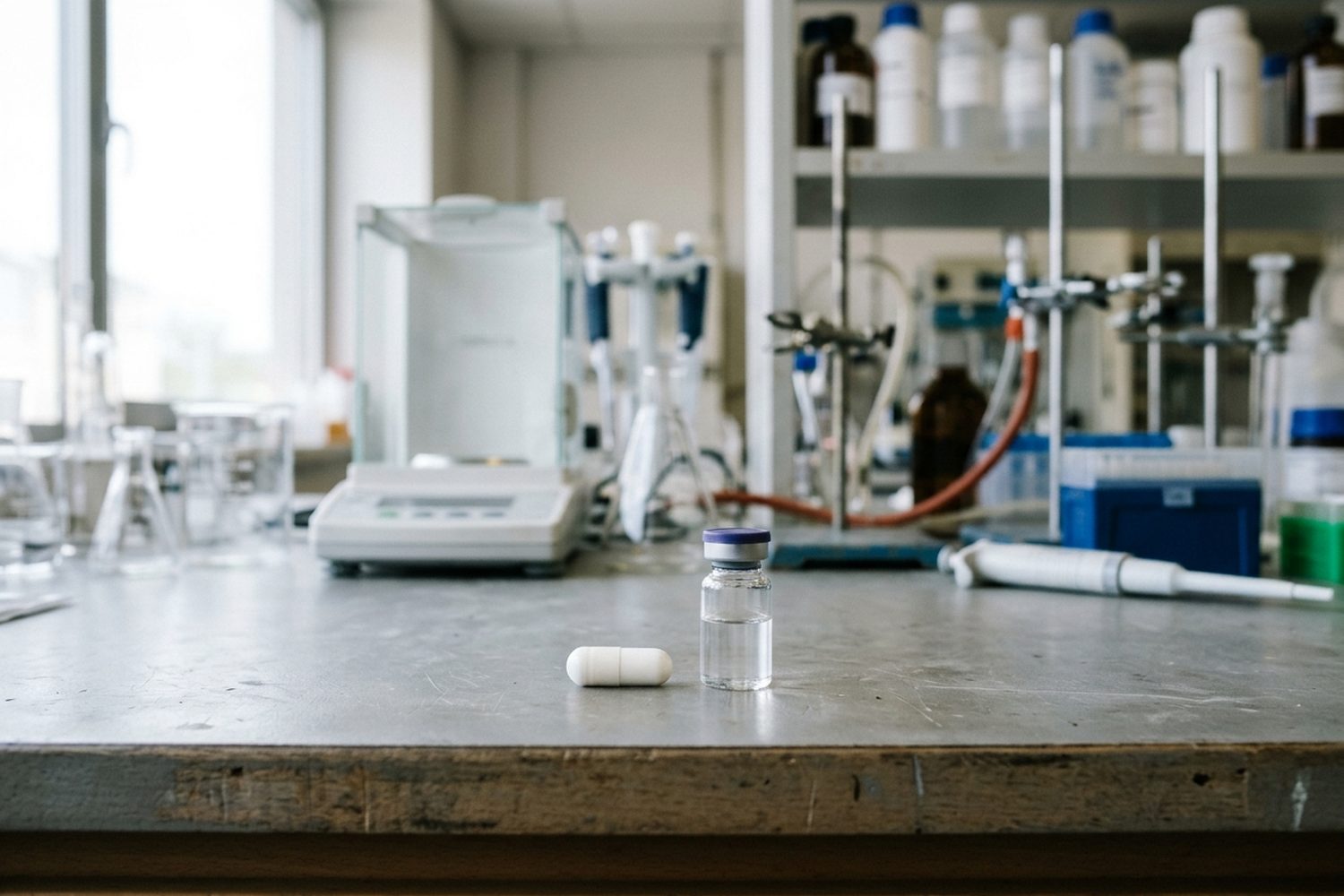
The drugs that made this corner of medicine famous are made of roughly the same stuff as lunch, and for most of their history that meant they came in a needle. A paper on the structural biology of these drugs puts it flatly: “Currently approved GLP-1R agonists are peptide-based.” A peptide is a chain of amino acids, and your digestive system is a machine whose whole purpose is cutting chains of amino acids into pieces. Swallowing one is a bit like mailing a letter through a shredder.
So there are two ways to make an oral GLP-1. You can keep the peptide and surround it with enough formulation chemistry (absorption enhancers, coatings, and so on) that some of it survives the trip and gets into the blood. Or you can drop the peptide altogether and build a small molecule, a different class of chemical, that still switches on the GLP-1 receptor. The second route now has its first Phase 3 success, Eli Lilly’s orforglipron, and a review article describes it in one sentence that holds the whole story if you read it slowly enough: “Orforglipron is an oral small-molecule, non-peptide GLP-1 receptor agonist developed by Eli Lilly.”
What one sentence about orforglipron is actually claiming
I am going to read that sentence the way a lawyer reads an indemnification clause. (This is the kind of thing I enjoy more than is socially reasonable.) It has five working parts: “oral,” “small-molecule,” “non-peptide,” “GLP-1 receptor agonist,” and “developed by Eli Lilly.” Each one is doing real work. Two of them look redundant and are not.
Take “oral” first, with appropriate solemnity. For purposes of this analysis, a drug is “oral” if it (a) enters the body through the mouth and (b) is still a functioning drug when it reaches somewhere useful. Both limbs are required. Plenty of things satisfy limb (a). Limb (b) is where peptides fail.
Why an oral GLP-1 peptide is so hard to make
Tirzepatide, for instance, is a “39-amino-acid synthetic peptide.” That is a small protein. Well, more precisely, it is a short chain of the same building blocks your stomach and intestine spend all day producing from food, so in some sense a peptide drug is a molecule assembled from exactly the pieces digestion is designed to leave behind. The body does not hold it in any special regard. It gets digested like everything else.
Here is a scenario, entirely made up, that shows the problem. Suppose you want a steak to reach your bloodstream intact. You coat it in something acid-resistant. Then you add a chemical that briefly makes the gut wall more permeable, so a whole steak can squeeze through. Then you discover only a tiny fraction gets through, so you swallow a much larger steak every morning, on an empty stomach, with precisely measured water, and wait before breakfast. Eventually you are running a small logistics company in your own esophagus. That is a caricature of the absorption-enhancer route, but only a caricature.
And it can work. Novo Nordisk’s amycretin, a peptide that hits both GLP-1 and amylin receptors, has been tested as a pill: in a phase 1 trial, the group assigned 100 mg per day of oral amycretin lost a mean 13.1% of body weight versus 1.2% on placebo after 12 weeks. A 2026 review lists “oral peptide formulations” among the approaches still in clinical evaluation. What the facts in front of me do not settle is how much of a swallowed peptide actually gets absorbed, or how that compares with the small-molecule route. I don’t know, and I would rather say so than guess.
What “small-molecule, non-peptide” means at the receptor
You might read “small-molecule, non-peptide” as saying the same thing twice, the way contracts say “null and void.” It is not quite that. “Small-molecule” is about size and how the thing gets made. “Non-peptide” is a promise about what it is not: not a chain of amino acids, and so not something the gut knows how to dismantle on sight. Most of the oral problem goes away inside those two words.
The trouble moves to the receptor. The GLP-1 receptor belongs to a family that, per one structural review, follows “a two-step model for peptide binding and receptor activation.” The hormone’s tail end grabs the receptor’s outer domain, and its front end reaches into the transmembrane core and sends the signal. A cryo-EM study describes the GLP-1 peptide as “clasped” between those two parts, further stabilized by the receptor’s extracellular loops. The receptor evolved to be held by a long, floppy peptide at two points at once.
A small molecule has no tail to grab with. It has to turn the switch without the handle. It is Indiana Jones swapping the golden idol for a bag of sand, except the goal is for the pedestal to notice and react exactly as if the idol were still there. You can picture the meeting where this started:
“The hormone works great. It just gets digested.”
“Okay. What if it weren’t a hormone?”
The proof of concept came from a compound called LY3502970 (also known as OWL833), which a structural paper calls “a nonpeptide GLP-1R agonist with a pharmacokinetic profile favorable for oral administration.” Taken by mouth, it lowered glucose in mice engineered to carry the human GLP-1 receptor. Mice are not people. (This is the most repeated sentence in biomedicine, and it keeps being true.) But the switch turned.
What “GLP-1 receptor agonist developed by Eli Lilly” commits to
“GLP-1 receptor agonist” is the functional claim: the molecule activates the receptor, whatever it looks like. That is the part that has to be shown in humans, and it has been. Lilly says orforglipron is “the first oral small-molecule GLP-1 receptor agonist to successfully complete a Phase 3 trial,” with HbA1c falling by an average of 1.3% to 1.6% across doses. Note how many qualifiers sit in that claim: oral, small-molecule, Phase 3. Each one narrows the field it was first in. (That is how firsts generally work in pharma, and I guess also in Little League.)
Then “developed by Eli Lilly,” the most boring clause, which is of course where the business lives. Lilly positions orforglipron as potentially the first oral GLP-1 receptor agonist approved specifically for obesity. “Specifically for obesity” is another careful qualifier. And “developed” is the kind of word that, in a drug’s biography, can cover anything from conceiving the molecule at the bench to spotting someone else’s very promising compound early (a compound with two names, say, is sometimes just a compound with two names). I suppose all the clause strictly promises is whose name is on the trials.
Who else is taking the small-molecule route
Look, a sentence that begins “the first” implies a second. HRS-7535 is another oral small-molecule GLP-1 receptor agonist that showed efficacy in a multicenter phase 2 trial in type 2 diabetes patients not controlled on metformin and SGLT2 inhibitors. Aleniglipron is one in development for obesity, with phase data published by Rosenstock and colleagues in Nature Medicine in 2026. The field site’s pipeline page has the full roster; the point here is just that the non-peptide trick has been reproduced.
It is also spreading past GLP-1. Structure Therapeutics has ACCG-2671, an oral small molecule that binds the amylin and calcitonin receptors and produced dose-dependent weight loss in obese rats, with additive effects alongside semaglutide. Amylin is another peptide hormone, so the same logic applies: if the peptide cannot survive the stomach, build something that is not a peptide and that the receptor cannot tell apart.
Which brings us back to the clause-by-clause reading. “Oral” was the goal, and “small-molecule, non-peptide” was how you get there. Put the two together and the sentence quietly says something strange. The leading oral version of a gut hormone drug is the one that contains none of the gut hormone.
Sources
- Lilly's oral GLP-1, orforglipron, demonstrated statistically significant efficacy results and a safety profile consistent with injectable GLP-1 medicines in successful Phase 3 trial
- Orforglipron, an Oral Small-Molecule GLP-1 Receptor Agonist for Obesity Treatment
- Efficacy and safety of orforglipron in adults with body mass index of 27 to less than 30 kg/m2 and adiposity-related complications: A post hoc analysis of the ATTAIN-1 trial
- Orforglipron for obesity treatment in older patients ≥65 years with or without type 2 diabetes: A post hoc subgroup analysis of the ATTAIN-1 and ATTAIN-2 trials
- Lilly's oral GLP-1, orforglipron, demonstrated statistically ...
- Efficacy and safety of HRS-7535, a novel oral small-molecule glucagon-like peptide-1 receptor agonist, in participants with type 2 diabetes mellitus inadequately controlled by metformin and sodium-glucose co-transporter 2 inhibitors: a multicentre, randomised, double-blind, placebo-controlled, parallel-group Phase II trial.
- Oral small molecule GLP-1 receptor agonist aleniglipron in ...
- 2184-LB: Novel Oral Small Molecule ACCG-2671—A Dual Amylin and Calcitonin Receptor Agonist Development Candidate for Obesity Therapy
- The Cardiovascular Effect of Tirzepatide: A Glucagon-Like Peptide-1 and Glucose-Dependent Insulinotropic Polypeptide Dual Agonist
- Cryo-EM structure of the activated GLP-1 receptor in complex with a G protein
- Structural basis for GLP-1 receptor activation by LY3502970, an orally active nonpeptide agonist
- Advances in the management of obesity: non-pharmacological strategies, herbal formulations, current pharmacotherapy, emerging drugs, and future perspectives
- Amycretin in obesity: Mechanisms, clinical efficacy, and ...
- Lilly orforglipron oral GLP-1 phase 3 weight loss trial
- Insights into the structure and activation mechanism of some class B1 GPCR family members
- Structural basis for ligand recognition of incretin receptors
- Novo Nordisk advances early-stage obesity medication, amycretin, to phase 3 clinical development based on early-phase clinical trial results in people with obesity or excess weight, published in The Lancet
- Amycretin in obesity: Mechanisms, clinical efficacy, and future perspectives
Incretin Drug explains published research. It is not medical advice, and it never recommends a dose, a product or a seller. Talk to a clinician before you start, stop or change any medicine.