The Wegovy Pill: How Oral Semaglutide Works
The swallowed version of semaglutide works by sending in about twenty times the molecule and hoping a little survives the stomach.
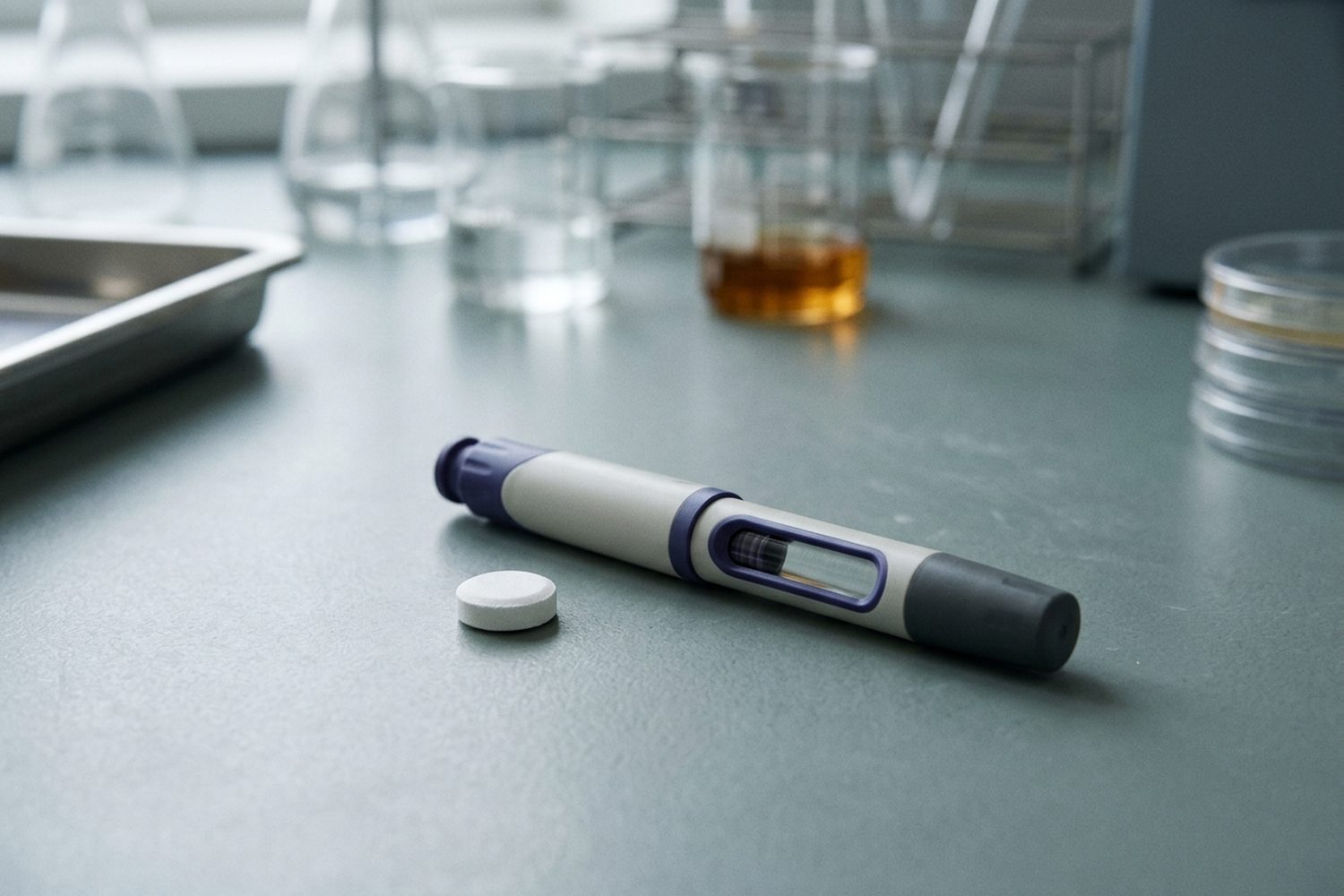
Novo Nordisk sells a drug called semaglutide as a once-weekly injection named Wegovy, at a dose of 2.4 milligrams. It has also run phase 3 obesity trials of a version you swallow, and that version used a dose of 50 milligrams. Same molecule. Roughly twenty times the amount.
So here is the plain answer for anyone who searched it: the Wegovy pill is oral semaglutide, the same GLP-1 peptide that is in the injection, formulated with an absorption enhancer called SNAC so that some of it makes it from the stomach into the blood. Most of it does not make it, which is why the dose is so much bigger than the shot’s. A 2026 systematic review put its placebo-subtracted weight loss in adults without diabetes at 14.3%. Whether and when it is approved for weight loss in any particular place is something the sources I am working from do not settle, so I will not pretend they do.
Why you can’t just put the injection in a pill
Start with the small, reasonable version of the problem. Semaglutide is a peptide, which is a short chain of amino acids, which is to say it is a small piece of protein. The human digestive tract is, professionally, a machine for taking protein apart (this is the whole point of lunch). If you swallow a peptide drug, your stomach does not know it is medicine. It treats it like a bite of chicken.
An injection skips all that. You put the molecule under the skin, it goes into the blood, and it does its job, which for semaglutide is mimicking the gut hormone GLP-1 (the site has a whole article on what an incretin is, so I will leave that there). Wegovy got its weight-loss approval in 2021 as a weekly shot. In the STEP-1 trial, which enrolled 1,961 adults with obesity or overweight, people on semaglutide 2.4 mg lost 14.9% of their body weight on average, versus 2.4% on placebo, and 69.1% of them lost at least 10%.
That is a good drug. On the other hand, it is a needle. Everyone involved here is acting sensibly from where they stand: lots of people would rather swallow something than inject it, Novo would like to sell its molecule to those people too, and regulators would like to see that the swallowed version actually does what the injected one does. That’s fine. It just means somebody has to get a protein through a stomach.
How much semaglutide you have to swallow, escalating
Here is a hypothetical, and I am making it up as I go. You are a formulation chemist. Your boss hands you the 2.4 mg weekly dose and says “put this in a tablet.” You do. Almost none of it reaches the blood, because the stomach digests it and the gut lining is not in the habit of letting big molecules wander through.
So you add more semaglutide. Some fraction survives. Then you add a helper molecule whose job is to get the peptide across the gut wall, and a bit more survives. Then you notice that the amount surviving is still tiny, so you add more peptide again. At the weekly meeting someone says “okay, but what if we just make the whole tablet bigger,” and nobody has a better idea, so you do that.
Now push it. Keep going and you end up with a drug that is absorbed so badly that patients eat it by the bowl. A breakfast cereal of semaglutide, sold in the Costco-size box, where each flake is mostly helper molecule and a little bit of medicine, and the pharmacist says “your prescription is out back by the loading dock.” The manufacturing plant has to produce a mountain of peptide so that a thimble of it shows up in anyone’s bloodstream. The economics are weird. The chemistry is merely sad.
How far along that road is the real world? Somewhat far. The injection is 2.4 milligrams. The oral dose in the phase 3 obesity work was 50 milligrams.
Dwelling on the number 50
I would like to spend a moment with 50, because it is a marvelous number in this context. Fifty divided by 2.4 is 20.83. So each oral dose contains about twenty-one injections’ worth of semaglutide. (My job, it turns out, consists largely of dividing one number by another and then acting surprised.)
And that is per dose. The injection is weekly. If a pill were taken every day (the sources I have do not spell out the schedule, so treat this strictly as arithmetic on a hypothetical), the weekly total would be 350 milligrams against the shot’s 2.4, which is about 146 times as much molecule to land in roughly the same place. The point is that almost all of what you swallow is, in the end, chicken.
This is the core answer to why the oral dose is so much larger. It is not that the pill is a stronger drug. It is the same drug, delivered through a route that throws most of it away, so you have to start with a lot more to finish with enough.
How SNAC gets the Wegovy pill past the stomach
The helper molecule in the real product is SNAC, the absorption enhancer. The general idea of an absorption enhancer is to make the local environment friendlier for long enough that a large molecule can get across the gut lining, rather than being broken up first. SNAC’s role is basically that of an escort: it accompanies the peptide on a short trip it could not manage alone and makes sure it gets where it is going.
The detailed chemistry of how SNAC does this is not in the sources I am working from, so I am not going to invent it. What the sources do establish is the result: enough semaglutide gets through, at 50 mg, to produce weight loss in the same territory as the shot. It is a little like the heist in Ocean’s Eleven, if most of the crew got caught at the door and the plan was simply to bring a much larger crew.
What the OASIS trials and the reviews showed
The phase 3 program for oral semaglutide in obesity (the OASIS trials) was early to the finish line. A 2024 paper, “Emerging pharmacotherapies for obesity: A systematic review,” put it this way: “Oral semaglutide 50 mg was the only emerging antiobesity medication to have completed a phase 3 trial as of the 2024 systematic review.” Everything else in the oral obesity pipeline was, at that point, still on the way.
The efficacy number is the 2026 systematic review’s: placebo-subtracted weight loss of 14.3% for oral semaglutide in adults without diabetes, with a 95% confidence interval of 17.2% to 11.4%. For comparison, a review in Annals of Internal Medicine covering 26 trials and 15,491 adults without diabetes put subcutaneous semaglutide at 13.9%. I feel like the obvious reaction is that the pill seems to do at least as well as the shot, which is weird for a drug that loses most of itself on the way in. But these are different analyses pooling different trials, and the honest reading is that the two land in the same range, not that swallowing is better.
There is also cardiovascular data. The SOUL trial, according to a review titled “GLP-1-based therapies in cardiovascular disease,” “reported a 14% reduction in MACE with oral semaglutide,” MACE being major adverse cardiovascular events, meaning heart attacks, strokes, cardiovascular deaths and so on. The weight-loss drugs keep turning out to be heart drugs, etc.
Where the pill sits in the pipeline
One review of GLP-1 biology says that dual and triple agonists, biased agonist design, and oral formulations are “the three major axes of next-generation incretin drug development.” Translated: drug companies are trying to make these molecules hit more receptors, hit them more cleverly, or come in a pill. Oral semaglutide is the third axis done the brute-force way.
The other way is a small molecule that is not a peptide at all and so does not get digested, which is what Eli Lilly’s orforglipron is (it has its own article here). Anyway, Novo has not abandoned the brute-force approach. Its oral amycretin, a single molecule hitting GLP-1 and amylin receptors, produced 13.1% weight loss versus 1.2% on placebo after 12 weeks in a phase 1 trial, at 100 mg per day, and a phase 3 oral trial called AMAZE 9 began recruiting in August 2026. Big peptide, big dose, big tablet, or whatever. If you want people to swallow your peptide, you had better make a great deal more of it.
Sources
- Cardiovascular protection beyond glucose lowering: GLP-1 receptor agonists and dual GIP/GLP-1 receptor agonism in contemporary cardiology
- GLP-1-based therapies in cardiovascular disease: outcomes, mechanisms, and emerging clinical applications
- Emerging pharmacotherapies for obesity: A systematic review
- Efficacy and Safety of Glucagon-like Peptide-1 Receptor Agonists and Co-agonists for Weight Loss Among Adults Without Diabetes : An Updated Systematic Review
- Novo Nordisk advances early-stage obesity medication, amycretin, to phase 3 clinical development based on early-phase clinical trial results in people with obesity or excess weight, published in The Lancet
- Amycretin in obesity: Mechanisms, clinical efficacy, and future perspectives
- Zenagamtide (Amycretin) Status 2026: Not Approved, Phase 3
- Lilly orforglipron oral GLP-1 phase 3 weight loss trial
- GLP-1 receptor biology and the therapeutic role of incretin-based agonists in metabolic diseases
- Lilly's oral GLP-1, orforglipron, demonstrated statistically significant efficacy results and a safety profile consistent with injectable GLP-1 medicines in successful Phase 3 trial
- Orforglipron, an Oral Small-Molecule GLP-1 Receptor Agonist for Obesity Treatment
- Efficacy and safety of orforglipron in adults with body mass index of 27 to less than 30 kg/m2 and adiposity-related complications: A post hoc analysis of the ATTAIN-1 trial
- Orforglipron for obesity treatment in older patients ≥65 years with or without type 2 diabetes: A post hoc subgroup analysis of the ATTAIN-1 and ATTAIN-2 trials
- Retatrutide Achieves Up to 30.3% Average Weight Loss in Phase 3 TRIUMPH-1 Trial | AJMC
Incretin Drug explains published research. It is not medical advice, and it never recommends a dose, a product or a seller. Talk to a clinician before you start, stop or change any medicine.